2
2

Helium
Helium – Helium – Hélium – Hélio – ヘリウム – Гелий – 氦
 He
He

Elementymology & Elements Multidict |
|
2
|
Helium
Helium – Helium – Hélium – Hélio – ヘリウム – Гелий – 氦
|
He
|
|
Multilingual dictionary
Indo-European
Helium Latin— Germanic
Helium AfrikaansHelium Danish Helium German Helium English Helium Faroese Helium Frisian (West) Helín Icelandic Helium Luxembourgish Helium Dutch Helium Norwegian Helium Swedish — Italic
Elio AragoneseHeliumu Aromanian Heliu Asturian Heli Catalan Hélio Spanish Hélium French Eli Friulian Helio Galician Elio Italian Éli Lombard Eli Occitan Hélio Portuguese Heliu Romanian - Moldovan — Slavic
Хелий [Helij] BulgarianHelij[um] Bosnian Гелій [helij] Belarusian Helium Czech Helij Croatian Él Kashubian Хелиум [Helium] Macedonian Hel Polish Гелий [Gelij] Russian Hélium Slovak Helij Slovenian Хелијум [Helijum] Serbian Гелій [helij] Ukrainian — Baltic
Helis LithuanianHēlijs Latvian Helis Samogitian — Celtic
Heliom BretonHeliwm Welsh Héiliam Gaelic (Irish) Hèiliam Gaelic (Scottish) Hailium Gaelic (Manx) Helyum Cornish — Other Indo-European
Ήλιον [hilion] GreekՀելիում [helium] Armenian Helium[i] Albanian — Indo-Iranian/Iranian
Hêlyûm KurdishГелий [gelij] Ossetian Гелий [Geli'] Tajik — Indo-Iranian/Indo-Aryan
হিলিয়াম [hiliẏāma] Bengaliهلیم [hlym] Persian હીલિયમ [hīliyama] Gujarati हिलियम [hiliyama] Hindi Finno-Ugric
Heelium EstonianHelium Finnish Hélium Hungarian Гелий [Gelij] Komi Гелий [Gelij] Mari Гели [geli] Moksha Heelium Võro Altaic
Helium AzerbaijaniГели [Geli] Chuvash Гелий [gelij] Kazakh Гелий [Gelij] Kyrgyz Гели [geli] Mongolian Helyum Turkish گېلىي [geliy] Uyghur Geliy Uzbek Other (Europe)
Helioa Basqueჰელიუმი [heliumi] Georgian Afro-Asiatic
هيليوم [hiliyūm] Arabicהליום [helium] Hebrew Ħiljum, ²Elju Maltese Sino-Tibetan
Hoi (氦) Hakkaヘリウム [heriumu] Japanese 헬륨 [hellyum] Korean ฮีเลียม [hīliam] Thai Heli Vietnamese 氦 [hai4 / hoi6] Chinese Malayo-Polynesian
Helio CebuanoHelium Indonesian Haumāmā Māori Helium Malay Other Asiatic
ഹീലിയം [hīliyam] Malayalamஹீலியம் [hīliyam] Tamil Africa
Eliyúmu LingalaHeliamo Sesotho Heli Swahili North-America
Tōnatiuyoh NahuatlSouth-America
Ilyu QuechuaCreole
Helimi Sranan TongoArtificial
Helio EsperantoNew names
Helion Atomic ElementsBalloonium Dorseyville |
History & Etymology
The French astronomer Pierre-Jules-César Janssen (1824-1907) went to India to observe the 1868 total solar eclipse and to make the first spectroscopic study of the sun's chromosphere. He noted a yellow spectral line which did not quite match Sodium or any other element.
Mary Elvira Weeks says that in the light of present knowledge the name Helium is a misnomer, for it has the suffix -ium which is characteristic of the names of the metals. The search for this new element in the Earth was not very productive until 1895, when Sir William Ramsay (1852-1916) was told by Henry Meirs, at the British Museum, that, on heating, a Norwegian mineral cléveite (clevite) gave off a gas that Meirs though might be nitrogen. Ramsay thought that it might be a compound of argon. In two days, he showed that it was a new inert gas, helium. In this gas spectrum the bright yellow stripe appeared, proving the existence of helium on Earth. It was independently discovered in clevite by the Swedish chemists Per Theodor Cleve (1804-1905) and Nils Langlet (1868-1936) about the same time.
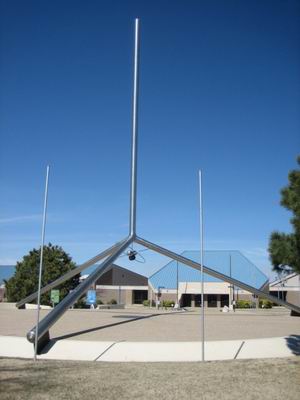
"HELIUM TIME COLUMNS
According to this text, the first columns should have been opened in 1993. The photo of monument and text are taken on 26 March 2006 and the opening is not mentioned.
Orthohelium and Parahelium or Asterium
Soon after Ramsay separated Helium and proved that it was chemically inert, similar to Argon, Carl Runge and Louis Paschen, wrote that Helium consists of the mixture of two gases: Orthohelium (= Helium) and Parahelium; one of them with a yellow spectral line, the other with a green line. They proposed to name the second gas Asterium, from the Greek astros = starry. Ramsay and Travers proved that it is erroneous, since the color of the spectral line of Helium depends on the gas pressure.
Coronium and Nebulium
After Helium was discovered by means of spectroscopical analysis of the total solar eclipse of 1868, astronomers began to point their telescopes at distant stars and nebulae. Their findings were scrupulously published in astronomical yearbooks, and some even found their way into chemical journals. These were findings which treated of alleged discoveries of new elements, which were given names such as Coronium (see Iron), Geocoronium (see Nitrogen), Nebulium (see Oxygen), Archonium, and Protofluorine (see Oxygen). Apart from their names, chemists knew nothing about them. But bearing in mind the Helium story, they placed these celestial strangers in the Periodic System before Hydrogen or in the space between Hydrogen and Helium. However, finally it was found out that the unusual spectral lines originated from known elements in unusual conditions, and Helium stayed the only element discovered outside the earth.
Proto-Hydrogen
Edward C. Pickering discovered ionized Helium lines in the hot star Zeta Puppis in 1896, and mistood it for a form of Hydrogen. Later these lines are found in other hot emission line stars and Wolf-Rayet stars. Pickering was convinced that the lines were due to Hydrogen under unknown temperature and pressure conditions. What was then called the "additional hydrogen lines" or the Pickering series could be fitted to the Balmer formula, provided half integral quantum numbers were allowed. Sir Norman Lockyer called the spectrum of ionized Helium Proto-hydrogen (note). Helios
 Helios [Ήλιος], son of Hyperion and Theia, is the Greek god of the sun. Each morning at dawn he rises from the ocean in the east and rides in his chariot, pulled by for horses — Pyrois, Eos, Aethon and Phlegon — through the sky, to descend at night in the west. He sees and knows all, and was called upon by witnesses. He was represented as a youth with a halo, standing in a chariot, occasionally with a billowing cloak. For more information, see: Encyclopedia Mythica.
Further reading
|
|