Statues - Hither & Thither |
Site Search:
|
|
Praha
Hlavní mĕsto Smetanovo nábřeží 18, Staré Město
|
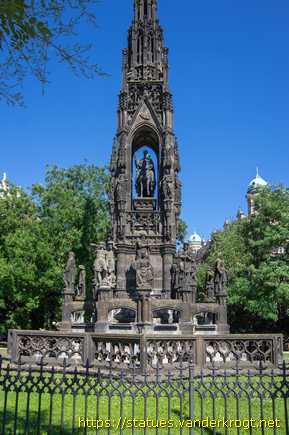
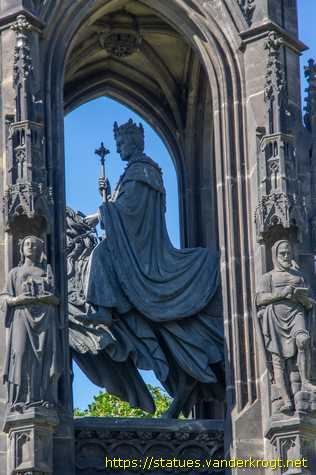
Krannerova kašna s jezdeckou sochou císaře Františka I.Kranner’s Fountain with a equestrian statue of Emperor Francis IKaiser Franz II/IFirenze 1768 - Wien 1835 the last Holy Roman Emperor as Franz II from 1792 to 1806, and the first Emperor of Austria as Franz I from 1804 to 1835. (Wikipedia) |
Josef Max & Josef Ondřej Kranner
1850 |
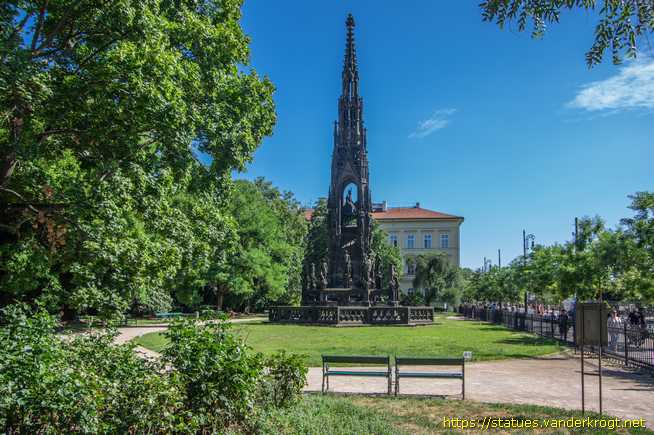
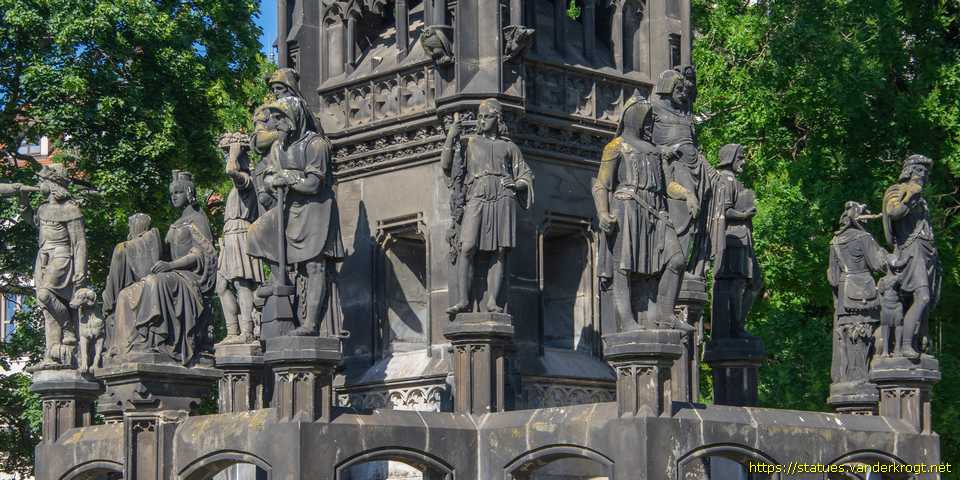
The Kranner Fountain on Smetana Embankment dates from the mid-19th century and was designed as part of the monument to Emperor Franz I, whose bronze equestrian statue is situated on it. After 1918, the statue was removed and placed in the storage facility of the Prague City Gallery. Following restoration, it was returned to its original location. Both the monument and the fountain are listed cultural monuments. The reason for the structural alterations was the investor’s intention to restore the existing fountain to working order. The above-ground part of the fountain consists of two sections – a shallow basin situated approximately at ground level and a plinth, which is positioned in the centre of the basin. The basin has the floor plan of a regular eight-pointed star, with a moulded stone balustrade. The lower part of the fountain is shaped like a cross, at the corners of which are allegorical statues. The central section is square in shape, with partially recessed circular columns at the corners; between them, on each wall, are openings with circular lintels from which water flows. Beneath the lower part of the plinth is a space connected by a passageway to Divadelní Street. The passageway houses the drainage system and a new water supply connection for the fountain.
The contract with Josef Max is set out in his extensive biography by Müller of 1877. On 13 January 1845, it was agreed that: "The academic sculptor Mr Joseph Max hereby undertakes the execution and production of all the statues intended to adorn this fountain, in accordance with the design by Master Builder Kranner, (...) namely:
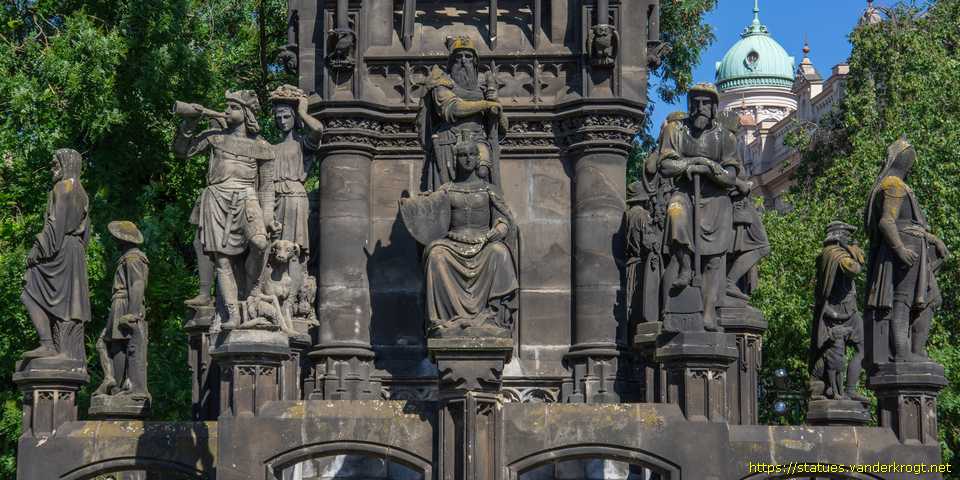
a.) 16 statues representing the 16 districts of Bohemia, and one statue representing the city of Prague,
on the lower tier of the fountain.
b.) 8 statues, intended to allegorically represent the arts, sciences and trades of peace, at the ends of the upper main niche,
and finally
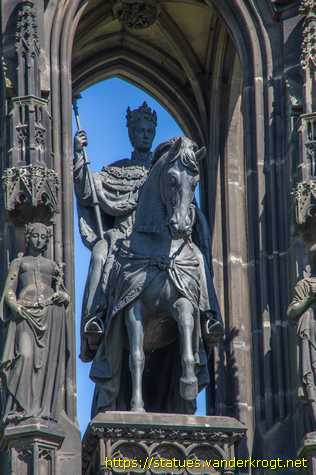
c.) the equestrian statue in this main niche, depicting His Majesty Emperor Franz I in his Bohemian
coronation regalia.
|
|
Equestrian statue of Emperor Franz I, in the full coronation regalia of a King of Bohemia. It is a replica of the original statue by Josef Max, installed in 2003.
Starting on the west side, then south, east and north.
In the 1845 these are described as "the arts, sciences and trades of peace.". In the article in the Illustrirte Zeitung of 1850 these eight statues are described as "The eight allegorical figures of Bohemian national culture - four male, four female - are: industry, trade, mining, agriculture, peace, art, science, fertility - abundance."
In various recent sources the allegory of peace is identified as an allegory of faith.
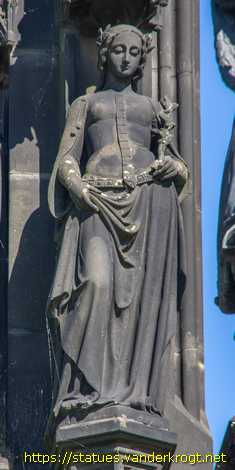 a. Mír / Peace: Female figure with blossoming olive branch. |
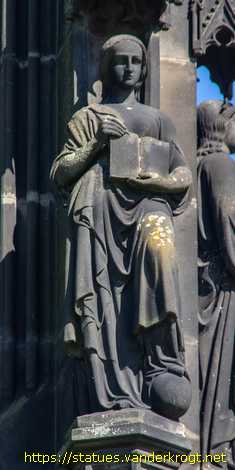 b. Veda / Science: Female figure with book. |
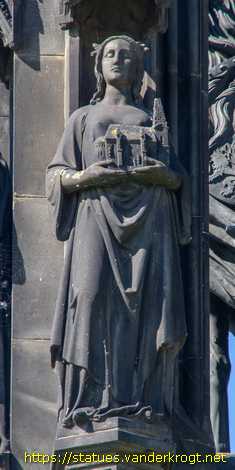 c. Umění / Art: Female figure with church model (architecture?). |
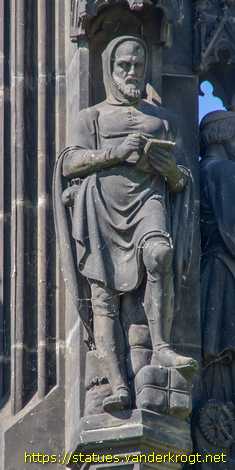 d Obchod / Trade: Male figure with notebook and packages. |
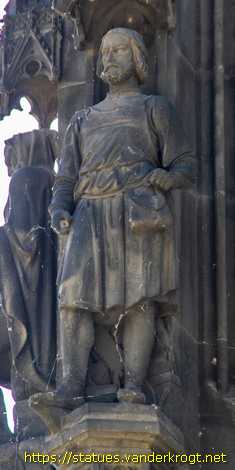 e. Prumysl / Industry: Male figure, attribute missing, with tools behind him. |
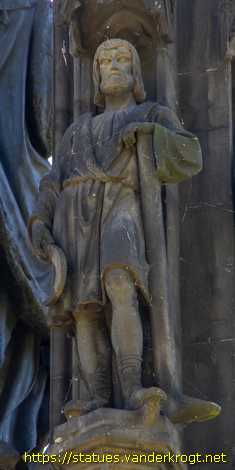 f. Rolnictví / Agriculture: Male figure with sickle en plow. |
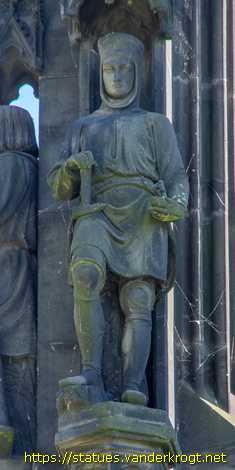 g. Hornictví / Mining: Male figure with mining tools. |
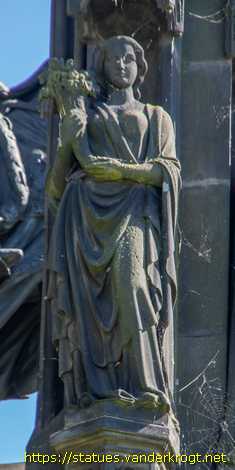 h. Hojnost / Abundance: Female figure with cornucopia. |
"The statues of the Bohemian districts - ingeniously conceived by Joseph Max, skilfully composed and carefully executed in fine-grained Glauputin sandstone-are all life-size and superbly characterised by their most distinctive productive, commercial, historical or other features."
The identification of the regions follows the article in the 1850 Illustrirte Zeitung and Müller's biography of Josef Max from 1870. The descriptions are translations of the 1850 article.
In her bachelor’s thesis, Drdáková attempted to identify the various regions on the basis of their attributes. Apparently, she was not familiar with the article from the Illustrirte Zeitung of 1850 and the 1870 biography, which led her to make a few incorrect identifications. Where her identifications differ, they are indicated in square brackets in grey letters at the end of each text.
In the text below, the German names of the regions are also given in brackets (to ensure consistency with the German-language sources).
Starting on the west side, then south, east and north.
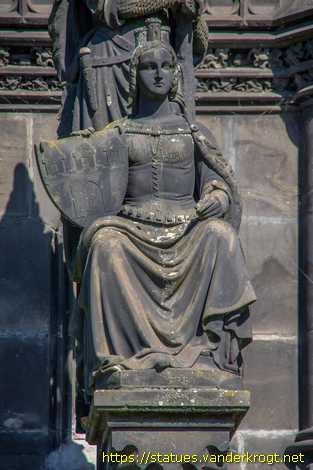 1. Praha (Prag): a maiden who, wearing a mural crown upon her head and holding a small oak twig in her right hand, sits upon a throne. |
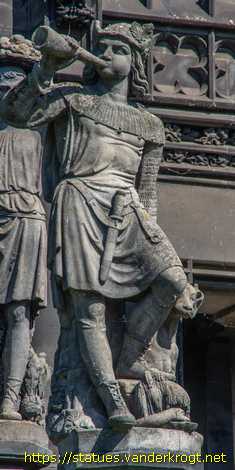 2. Loketský kraj (Elbogener Kreis): home to the healing springs of Marienbad, Franzensbrunn and Karlsbad, and whose forests harbour noble big game - represented by a dashing stag hunter blowing his horn because his hounds have discovered warm healing springs - alluding to the discovery of the Karlsbad spring by King Charles IV's stag hunter [Klatovský] |
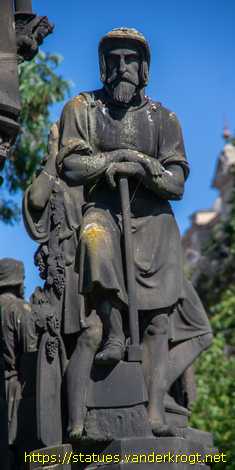 3. Plzeň (Pilsen): a sturdy blacksmith, resting on his massive sledgehammer, a representative of the iron-rich Pilsen district [Čáslav]. |
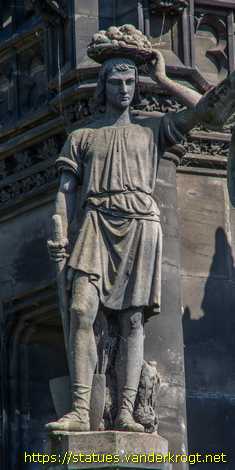 4. Kouřim (Kaurzim): a gardener, with a heavily laden basket of fruit upon his head [Bydžov] |
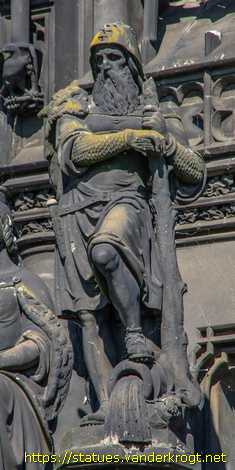 5. Bydžov (Bidschow): a sinewy inhabitant of the Giant Mountains, a cap of mist upon his wild head, a bearskin on his back, his arms resting on a huge club, one foot treading upon a rock from which the source of the Elbe trickles forth [Beroun]. |
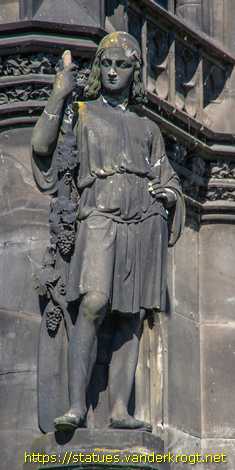 6. Litoměřice (Leitmeritz): a young boatman, whose oar is entwined with the Czernosek vine, with attributes of industriousness and trade at his feet |
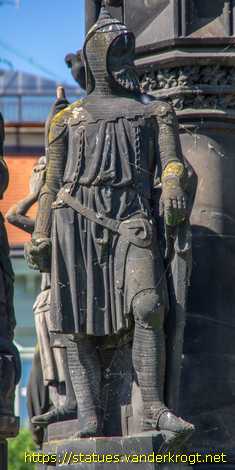 7. Hradec Králové (Königgrätz): - once, under the aegis of George of Podiebrad, the stronghold of the last militant Hussites, and now home to Bohemia's main fortresses, Königgrätz and Josephstadt - is represented by a proud warrior in full Old Bohemian armour with a gleaming sword [Boleslav]. |
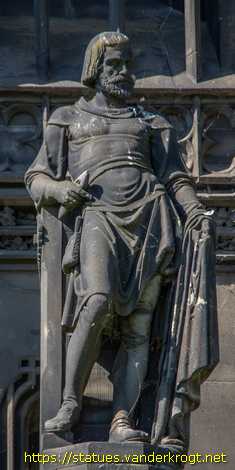 8. Boleslavský kraj (Bunzlauer Kreis): a cloth weaver [Hradec]. |
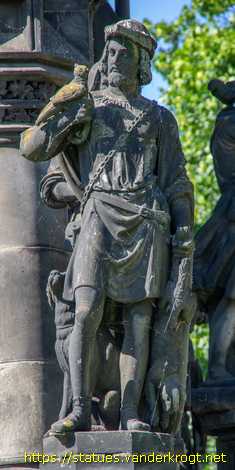 9. Čáslav (Tschaslau): A falconer personifies the district of Caslau, famous throughout Austria for its low-altitude falconry on the Auersberg estates [Prácheň] |
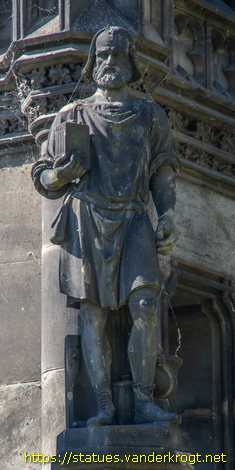 10. Klatovy (Klattau): a glassblower. |
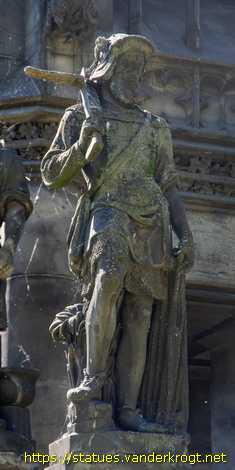 11. Budějovice (Budweis): A pond hunter with a crossbow and fishing net represents the Budweis district, whose territory encompasses the numerous large fish ponds of the Duke of Krumau, Prince of Schwarzenberg |
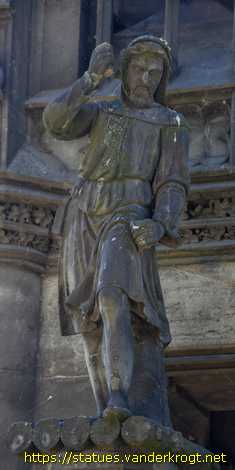 12. Prácheň (Prachens): which encompasses a large part of the Bohemian Forest, by a timber rafter [Kouřim]. |
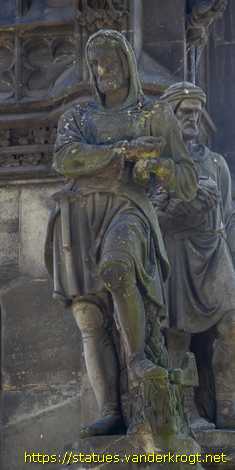 13. Beroun: a miner [Loket]. |
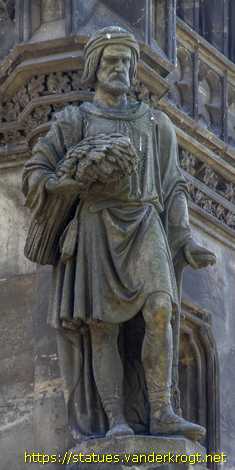 14. Rakovnice: a reaper with a sickle and a sheaf |
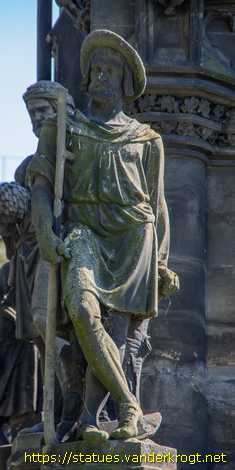 15. Tábor (Tabor): a wild-bearded, stocky day labourer, whose scythe is reminiscent of the dreaded Taborites of the 15th century, for whom it was a fearsome weapon. [Plzeň] |
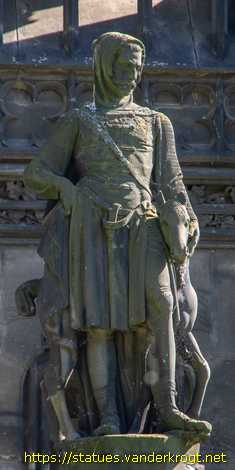 16. Chrudim (Crudim): the district which breeds the most horses is represented by a horseman in a Bohemian corded tunic, caressing a delicate foal |
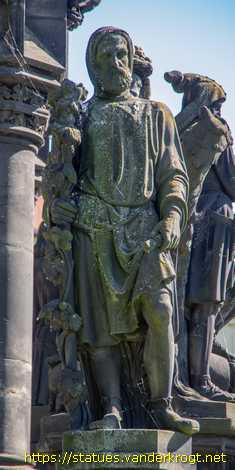 17. Žatec (Saaz): a hop grower; . |

Your banner here? Click for information.