

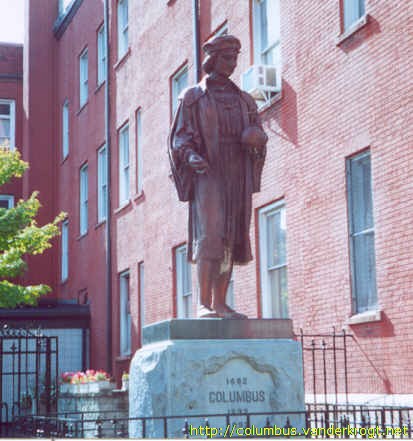
This text belongs to the Phillipsburg N.J. statue on the Columbus Monuments Page
On August 16, 1892, a group of parishioners of St. Philip and St. James Church, Phillipsburg, NJ met with their pastor, Father Emmett Burke, at his request, to decide how to raise the necessary funds to purchase a statue of Christopher Columbus. The statue was to commemorate the 400th anniversary of the landing of Columbus on San Salvador on October 12, 1492.
The committee decided to have medals cast and to sell then for $1.00 each to finance the purchase and installation of the statue. Nathan I. Eglit has described the medallions in COLUMBIANA in the following manner:
"#309. Landing of Columbus. Inscription above: 400th anniversary of the Discovery of America.
Below:
Oct 1492-Oct 1892.
Center: Full statue of Columbus holding a globe in his left hand and calipers in his right hand, mounted on a base.
Reverse Smooth faced. Above: Sts. Philip and James Church. Rev. R.E.Burke, Rector.
Below: Oct. 12, 1892. Phillipsburg, NJ
White metal, 38mm. Storer 236.
309A. Similar. Copper."
Members of Warren Council #474, Knights of Columbus, Phillipsburg, authenticated this medallion in 1960. Further records are filed in the Knights of Columbus Supreme Library, New Haven, CT. The late Jim Shelly, Alpha, NJ, located a white medal and loaned it to the committee. Dr. & Mrs. Benjamin Freyermuth, Easton, PA was instrumental in obtaining copper coins, which were given to Patrick Kearns to be donated to the parish. Original copper medals are also in the possession of Dr. and Mrs. Freyermuth and Edward Rafferty.
The V. H. Mullins Company made the statue, which was selected, in Salem, Ohio. They used a design of the famous sculptor Alfons Pelzer.1 It was based on an original painting of Columbus, which is considered to be the greatest likeness of the famous explorer. It was the official Columbus picture adopted by the 1893 Columbian Exposition in Chicago, and considered by them to be "the most pleasing and historically, the most correct". The 9-foot statue was formed from copper sheets with an internal steel armature for stability. In his left hand Columbus held a globe and in the right a pair of calipers. On his left stood a pedestal on which was a globe with a dove.
The committee must have been very relieved when the statue of Columbus finally arrived at the Bel-Del depot on October 11, 1892 the day before the celebration. It seems the precious statue had been sent to Phillipsburg, PA by mistake.
The following excerpt from the October 12, 1892 Easton Express indicates the importance of the occasion and the preparedness of the townspeople for this historic event: "The town is decorated with flags and bunting and presents a gay appearance. The schools are closed, the silk mill shut down at noon and business generally is suspended. Pictures of Columbus can be seen in nearly every business window on Main St. The church, parochial school building and the pastoral residence are profusely decorated. The interior of the church is also decorated.
The day of celebration started with a Low Mass at 7:30 a.m. followed by a High Mass at 9:00 a.m. celebrated by Father Burke. The parade followed and some of the marchers were:
The late Sir Knight, John Franceschino related a story that was printed in the July 8, 1960 edition of the Easton Express, "One hour before the parade began, a boy was born to a Mr. & Mrs. Gilluly. No one could think of a name until they heard the noise of the parade. Appropriately, they named him Christopher Columbus Gilluly. He is still a resident of Phillipsburg."
The statue stood on a small grassy area at the left-hand side of the church for 45-50 years. We have asked many parishioners and residents as to how and when the statue was moved to the schoolyard. Dr. John Kane advised the writer in February, 1992 that he remembers the statue being moved around 1922 or 1923, when the Sts. Philip & St. James High School was erected. He worked at a soda fountain across the street. He said that the statue was moved by the Flynn Construction Company and he told me that Mr. Flynn's son Joe worked at Ingersoll Rand's Phillipsburg plant and that maybe his widow Ruth would know where we could get further information. Joe's widow, Ruth Flynn, was not able to provide any further information. Two booklets, found in the Newark, NJ Library help to narrow the unknown time span: "The Phillipsburg NJ Charter Jubilee Centennial" booklet, dated 1911 shows the statue in front of the church, secondly, "The History and Directory of Warren County" by Frank Shampanore, dated 1929 shows the statue in front of the Parochial School building.
Samuel Matthews, Pasadena, CA, a former resident of Phillipsburg wrote a letter in July 1960 in which he related the following: "...About 30 years ago it was found that the statue was badly deteriorated at the base. The Monsignor of St. Philip & St. James Church pointed out it's condition to the Lodge: "Cesare Battista" of the Sons of Italy who were then meeting at the Eagles Hall on Market St. The lodge took on the responsibility of restoring the statue, and appealed to its sister lodges Sons of Italy in Easton to assist in raising the necessary funds, as they had paraded to Phillipsburg for years on Columbus Day for formal exercises. However, the Easton lodges did not wish to contribute money for the repairs, reasoning that, as it was a Phillipsburg statue they did not feel obligated to contribute to the funds. Due to this attitude the Phillipsburg lodge severed its joint celebration on Columbus Day with Easton and the annual parade was discontinued.
Subsequently the Phillipsburg Lodge named John DiMatteo chairman and almost single handily appealed and begged among the Italian families of Phillipsburg and was successful in raising the needed amount. If I recall correctly, a firm in Allentown, PA did the work. The supporting rods in the legs were replaced, the outer covering replaced and then the entire statue was given a bronze bath. When re-installed on it's base the statue looked like new."
According to Sam Trumbadore, a long time Easton resident the Columbus Day parade started at 5th and Ferry St., Easton proceeded down town, then across the Northampton St. Bridge, up South Main St. where the ceremonies were held for many years.
In 1960 because the statue was suffering from time, weather and vandalism, the members of Warren Council undertook the task of refurbishing the statue. John Franceschino, committee chairman and William "Doc" Herbert, Grand Knight, did extensive research with the help of Jim Shelly, a staff writer at the Easton Express.
Francis P. Moule, treasurer of Warren Council, recalled a letter he received while he was Mayor of Phillipsburg in 1955 from D. H. Jefries of Bluffton, Indiana who owned one of the original medals and wanted to know something of its history. When the medal came up for discussion by the council committee, Moule wrote to Jefries who subsequently loaned it to the Council. The Council members engaged in the restoration work from enlarged photographs of the medal in their attempts to make the restoration of the statue as authentic as possible.
The restoration included these steps: a steam bath, replacement of fingers, replacement of the dividers and one of the globes, repair of the shoes and various cracks, silver soldering of all repairs, an acid bath to restore the original color, coats of lacquer and a coat of clear plastic. A unique feature of the project was that only members of the Council were engaged in the restoration work.
On September 24, 1960 the statue was put back on its pedestal after a time capsule was placed in the base. The statue was in excellent condition. During the ensuing years the statue was subjected to vandalism and even an attempted robbery. Residents on South Main Street told us that they woke up one night to a terrible noise in the schoolyard. Vandals had put a chain around the statue, attached it to a truck and were attempting to pull it from its base. They were frightened away.
In 1977 someone detonated firecrackers in one of the shoes and it was completely destroyed. Warren Council members, Joe Janci, Tony DeBosh and Grand Knight Pat Kearns, were able to work with local craftsmen to replace the foot.
In the period from 1960 onward Warren Council #474, Knights of Columbus has had yearly ceremonies at the statue and has performed several repairs, but by 1990 it became apparent to members of Warren Council that a major overhaul of the statue was in order. On June 21, 1991, with the permission of the Pastor, Msgr. Michael J. Corona, Chaplain of the Council, the statue was removed from its base with the assistance of Warren Council members, Dominic and Tony Comito, and employees of the Easton Finishing Works.
The time capsule was removed and a letter signed by Grand Knight William F. Herbert and Chairman John Franceschino revealed the history as found in 1960. The capsule also contained a list of members who worked on the restoration namely, Michael Kovacs, Frank Stephen, Stephen Lubowici, John McLaughlin, Fred Marketti, Joseph Todaro, Harry Giorlando, Tony Belcastro, Edward Bullock, Past Grand Knight Francis Moule, Dominic Comito, Anthony Comito, and Robert O'Brien. The Easton Express, the Allentown Morning Call, Radio Station WEST, and the Easton Library were singled out for their assistance in the project. The capsule also contained some photos, damaged by moisture, of the restoration and of the medal.
Several restoration companies were contacted for estimates to repair the damages in 1992. The statue was extensively restored at the Cavalier Renaissance Foundry in Bridgeport, CT, under a contract with St. Philip & St. James parish. Some of the major improvements which were made include: replacement of missing fingers, removing dents in the body and legs, re-manufacturing damaged foot, strengthening the loose arms, correcting the pitting on the face, and, adding an internal brace to the head for better support. The exterior coating was removed and a protective coating on the copper statue was added.
The copper statue is riveted to an internal, steel armature, which provides two rings of support, one just below the waist and the second, at the center of the chest of the statue. The sheath is riveted to the rings. Support rods project from the rings to the feet, arms and the head. The internals were painted with rust inhibitors to prevent galvanic action between the armature and sheath.
The granite base was re-erected onto an 18-inch concrete slab. The block has hold down bolts at each corner, which are used to secure the statue's soleplate. The soleplate is a 1" steel plate with 6-in. projections for supporting the feet of the statue and for securing its hold down bolts. These bolts are tied into the armature and course down through the legs. Additional bolting is used to tie down the tip of the shoes to the soleplate. The time capsule is placed in the area between the soleplates base and the top of the projections. The time capsule contains copies of the original 1960 papers, a copy of an updated history, and literature on the 1992 fundraising and dedication.
A beautiful plaza was erected in basically the same location in front of the former St. Philip & St. James School, now known as Mercy Hall. On the side adjacent to the school playground a brick wall was erected while an attractive wrought iron fence surrounds the statue itself. Large globed lights on the wall pillars provide beauty and security. Funds for meeting the cost of Columbus Plaza, a joint effort of the parish and the council, were obtained by selling memorial paving stones, which surround the statue on the ground. Monsignor Michael Corona was Chairman. District Deputy, Ray Miller, Warren Council Quincentennary Chairman, was an active participant in the fund raising aspect of the project. Other members of the committee were Grand Knight Bruce Hall, and Past Grand Knights Patrick Kearns and Edward Rafferty.
In addition to donations from the Knights of Columbus on the state and local level, other supporters included: The Irish Society, the Catholic Daughters of the Americas, the Ladies Ancient Order of Hibernians, other parish groups and many individual families. A parishioner, architect Harold Scott Jr. and Monsignor Corona designed the Plaza.
The rededication of the statue and the dedication of the new Columbus Plaza were held on Sunday, November 8, 1992. Bruce Hall, Grand Knight of Warren Council, gave the address of welcome. Nearly 200 people braved a chill evening to hear Msgr. Corona's address after which he blessed the statue the Plaza and the newly renovated Parish Center and office complex in Mercy Hall.
POPE JOHN XXIII, General Assembly, Phillipsburg provided A Fourth Degree Honor Guard under the direction of Captain John LaCaruba, with the assistance of Faithful Navigator, Patrick Kearns. Members of Warren council in the Honor Guard included PGK Bernard Brotzman, St., PGK Bernard Brotzman, Jr., Stephen Hardick, James O'Brien, Paul Butler and PGK Edward Rafferty. Grand Knight Bruce Hall and Karl Osterloff, Master of the First New Jersey district, Fourth Degree placed a wreath at the statue.
A dinner followed in Mercy Hall attended by 200 people. Msgr. Corona gave the welcoming address and thanked everyone for his or her participation in the successful project. Past Faithful Navigator, Edward Rafferty, was the Dedication speaker. He traced the history of the statue and brought out its relationship to the other duplicate statues.
Considering the pathetic life of the Phillipsburg Columbus statue, which we have just reviewed, it is ironic that the October 12, 1892 item in The Express prophesied that "The day will be long remembered, ...and the statue will, according to the manufacturer's statements, last unendingly."
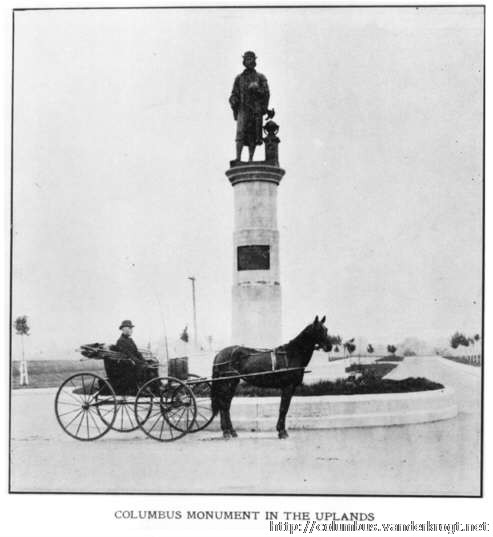
It might be interesting to note that as a result of considerable research, it was discovered that there were at least four statues made from the same mold in the Mullins factory.2 A newspaper in Chicago in an article dated July 1893, reported that a statue of Columbus was destroyed in a fire at the Columbian Exposition. It also mentioned that there were three other statues in existence. They were in Columbus, OH, New Haven, CT, and Phillipsburg, NJ. The one in Peoria, IL was not mentioned since it was not placed until 1907.
Mrs. Karen Deller, researcher of Peoria, IL has provided us with information on the Columbus statue that stands in Peoria's Bradley Park. This statue was badly damaged in 1982 and was repaired with funds generated by the three Peoria groups and citizens. The statue in Columbus, Ohio originally stood on the grounds of the Josephenum Seminary but in recent years has been moved to the State Capitol grounds. The statue has been refurbished and stands proudly on a magnificent base on the Capitol grounds. Incidentally, Father Terrence Lawler, a native of Phillipsburg, NJ graduated from Josephenum Seminary. The statue in New Haven, CT stands in Wooster Park at the corner of Chapel and Church Streets, not too far from Supreme Offices of the Knights of Columbus. We were not able to learn of the final fate of the original statue, which was sent to Chicago for the 1893 Centennial Exposition. We do know that it was in a fire in 1893 and may have been destroyed.

Notes: